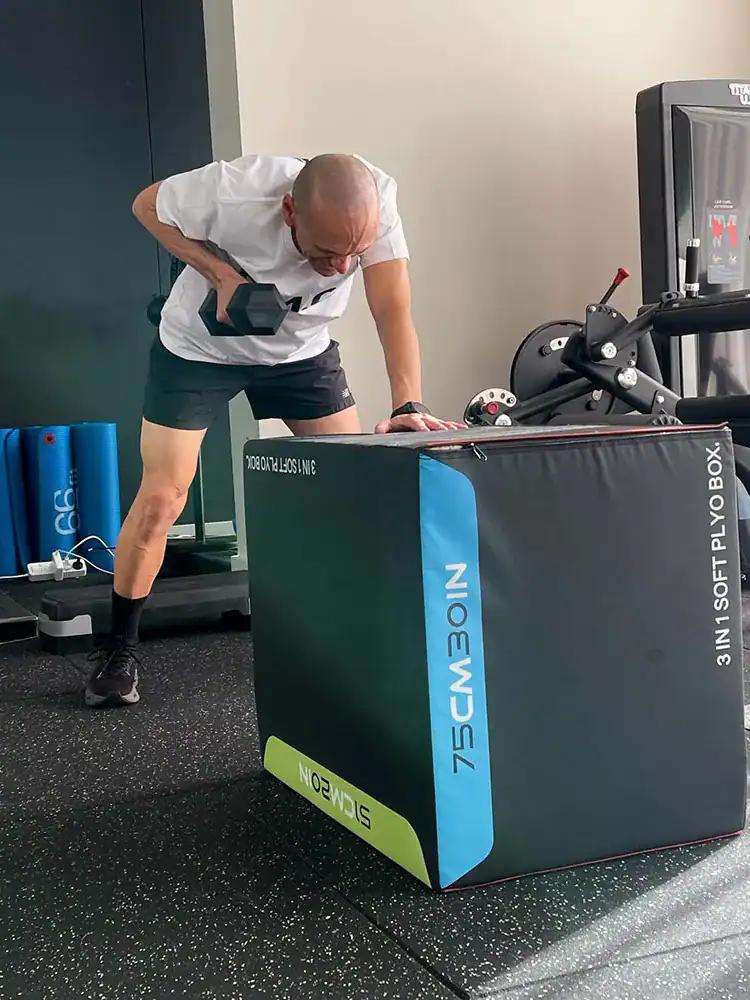
If you already strength train, do you really need Pilates?
We think it can be a pretty great addition.
Strength training should absolutely remain a cornerstone of your weekly exercise routine. It helps build muscle, maintain bone density, improve physical capacity and prepares your body for the demands of everyday life.
But that doesn’t mean every training session needs to involve lifting heavy weights.
Adding a Clinical Pilates session into your week can give you something slightly different: an opportunity to move through different ranges, slow things down, challenge control and coordination, and load your body in ways you might not normally encounter on the gym floor.
The two don’t need to compete. In fact, they can complement each other really well.
Strength training does a lot…but it doesn’t have to do everything
A good strength program will expose your body to progressive resistance.
Think squats, deadlifts, presses, rows, lunges and carries. Over time, we progressively increase the load or difficulty to make your muscles, bones and connective tissues more capable.
And we’re big fans of it.
But if your entire training week consists of similar exercises, similar movement patterns and increasingly heavy loads, adding some variety can be useful.
That’s where Clinical Pilates can fit in.
Clinical Pilates gives you a different movement challenge
Pilates isn’t necessarily a “better” movement. It’s simply a different movement.
A Pilates session might ask you to control your trunk while your arms and legs are moving, work through larger ranges of motion, coordinate multiple movements at once, or maintain control under sustained muscular fatigue/tension.
On a reformer, the springs can also provide assistance in one exercise and resistance in another, allowing you to explore movements that feel completely different to traditional gym exercises.
If you’re accustomed to lifting weights, that change of stimulus can be surprisingly challenging.
And yes, the person who can deadlift twice their bodyweight can still find themselves shaking during a Pilates exercise.
We see it all the time.
It challenges control, coordination and body awareness
When we lift heavy weights, the goal is often fairly simple, produce enough force to move the weight safely and efficiently.
Clinical Pilates can introduce a different challenge.
Slower tempos, sustained positions, unilateral exercises and movements requiring coordination between the trunk and limbs can make relatively light resistance feel surprisingly difficult.
It means you’re practising another aspect of physical capacity: being able to control your body across different positions, speeds and movement demands.
For runners, gym-goers and recreational athletes, having both strength and movement options available to you is useful.
What about mobility?
You don’t necessarily need a separate hour of stretching every week to work on mobility.
Many Pilates exercises naturally take joints through relatively large, controlled ranges of motion.
Rather than simply holding a stretch, you’re often producing and controlling movement through that range.
And yes, Pilates can make you stronger
Pilates is resistance exercise.
Depending on the exercise, spring resistance, lever length, tempo and your experience level, it can provide a significant muscular challenge.
Think of gym and pilates as complementary to one another.
You can do both.
The best program is rarely one type of exercise
At Better Movement Collective, we’re much more interested in helping people build capable bodies than convincing everyone that there is one “perfect” form of exercise.
For the everyday athlete, whether you’re training for a fun run, doing CrossFit a few mornings a week, chasing kids around the house or simply wanting to stay strong as you get older, Clinical Pilates can be a great way to add another dimension to your training.
You don’t have to swap the gym for the reformer.
Just make some room for both.
Want to add Clinical Pilates to your training week?
At Better Movement Collective in Hampton, our Clinical Pilates sessions are designed to complement an active lifestyle. Whether you already strength train, run, play sport or you’re simply looking for more variety in your week, we’ll help you find the right balance of strength, movement and recovery for your goals.
Mackenzie Topfer
Physiotherapist